LEVEL 1
Fundamental Child Protection Training for Employees (Non-Educators)
Safeguarding training for
Employees (Non-Educators)
Our Level 1 – Fundamental Child Protection Training for Employees (Non-Educators) course is an eLearning course that offers Child Protection training to employees who work in organizations that serve children.
The content meets international standards for Child Protection training.
The course provides 2 hours of professional learning, designed for non-educator employees, and is accessible on any internet-enabled device.
Read more about the features of the course below.
Training Designed For
Our Level 1 – Fundamental Child Protection Training for Employees (Non-Educators) was designed to meet the learning, language, and technical needs of non-educator employees working in organizations that serve children.
We also offer training for educators through our Level 1 – Fundamental Child Protection Training for Educators.
The course was designed by educators and Child Protection experts with decades of experience working with children, degrees in instructional design, and expertise in EdTech and eLearning.
Employees (Non-educators)
Try a Sample of the Course
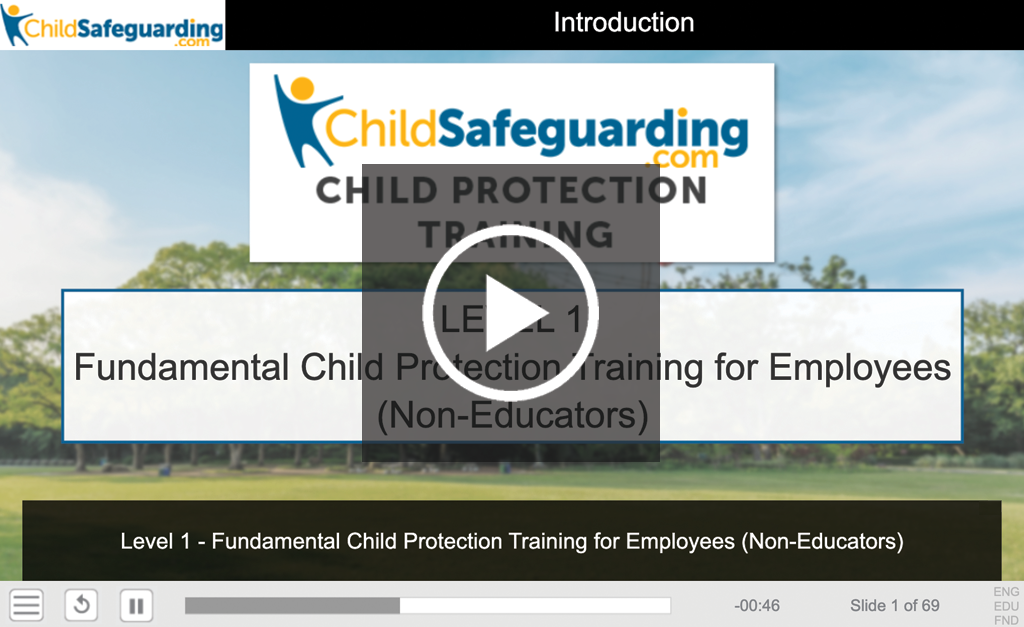
Try a 10-minute demo version of our Level 1 – Fundamental Child Protection Training for Employees (Non-Educators) course to see how the content is delivered, examples of activities and knowledge checks, and a sample of the case studies.
You will be able to choose the case study that includes children 5 years old and younger, 6 to 9 years old, 10 to 13 years old, or 14 years old and older.
Schedule a Demo
Learn more about ChildSafeguarding.com with a personal demo for your organization.
Course Evaluation and Recognition
Our Foundational course has been certified by The CPD Certification Service as conforming to continuing professional development principles.
Key Features
- Instructional Design
- Course Content
- Case Studies
- Customization
- Certificates
- Languages
- Connections
- Accessing the Course
Instructional Design
Our unique instructional design was written to meet the learning needs of adults working in organizations that serve children. We developed a learner profile that takes into account their educational experience, their professional experience, their diverse cultural backgrounds, and their range of knowledge in Child Protection, eLearning, and professional development.
Our Level 1 – Fundamental Child Protection Training for Employees (Non-Educators) course delivers Child Protection content that uses:
- A scaffolded approach
- A multimodal approach that includes visual, auditory, and textual content
- An interface accessible to learners of all technical experience levels
- A combination of instruction, activity, and formative assessment
- A case study approach that offers in-depth and applied learning
Every learner receives the same learning experience regardless of language.
Course Content
Our Level 1 – Fundamental Child Protection Training for Employees (Non-Educators) course was developed in partnership with Chris Gould of 112 Safeguarding. It was built upon the United Nations Convention on the Rights of the Child. The course aligns to international Child Protection training standards and legal frameworks.
Our course covers:
Part 1 – Child Protection and Your Duty of Care
Part 2 – Abuse Types, Behaviors, and Indicators
Part 3 – Concerns, Disclosures, and Your Responsibilities
Each part of the course includes sections of the case study, activities, and a knowledge check.
After the learner has completed the 3 parts, they will go through a course review and then be taken to the Final Assessment.
In order to pass the course and receive their Certificate of Achievement, the learner must achieve 80% correct on the Final Assessment.
The course takes about 2 hours to complete.
5 Years Old and Younger
6 to 9 Years Old
10 to 13 Years Old
14 Years Old and Older
Case Studies
Our Level 1 – Fundamental Child Protection Training for Employees (Non-Educators) course includes in-depth case studies that provide authentic learning experiences that meet the needs of adults working in organizations that serve children of various ages.
The case studies are presented in sections across the three parts of the course. In each part, the learner will engage in the case from the point of view of someone involved.
Part 1 – The viewpoint of the adult.
Part 2 – The viewpoint of the child.
Part 3 – The viewpoint of the organization.
We also offer a menu of case studies to ensure the learning experiences match the needs of the learner. They can choose from case studies designed for:
- Children 5 Years Old and Younger
- Children 6 to 9 Years Old
- Children 10 to 13 Years Old
- Children 14 Years Old and Older
The case studies are drawn from real events. They provide the learner an opportunity to apply their Child Protection knowledge and reflect on what they may have done in that situation.
Customization
Our platform allows organizations to include their logo and customized reporting information that is presented in the course in line with the rest of the content.
The organization logo is presented during the course when we discuss reporting Child Protection concerns at the organization.
The organization logo is also added to the Certificate of Achievement to show the course was completed in connection with the organization.
This custom reporting information is presented multiple times during the course. This allows learners to read the school’s reporting information and have it reinforced to them to report using the organization’s Child Protection reporting system..
As an example of reporting information, if a school has a Designated Safeguarding Lead that should be contacted for Child Protection reports, the school can add that person’s name, job title, and contact information to the course.
This customized logo and reporting information is presented live. If a school updates this information, it will be updated on all subsequent sessions and certificates, even those that are reprinted.
If learners successfully pass the Final Assessment, they will earn their Certificate of Achievement.
- The certificate is valid for up to 2 years
- It is presented in the language used in the course
- It is accessible at any time by clicking on the certificate link in the learner’s dashboard or Learner section of the organization’s dashboard
- It can be printed, downloaded, or emailed as well as shared to LinkedIn, Facebook, and X
- Cannot be altered
- Is digitally verifiable
- Can be shared on documents, professional profiles, and social networks, such as LinkedIn
Languages
A central focus of ChildSafeguarding.com is to make Child Protection training accessible to learners in multiple languages.
We present the course in these languages:
- At the point of entry to the course
- Throughout the course, in text, audio, and subtitles
- On all buttons, labels, webpages, and emails
- In the Knowledge Checks and Final Assessment
- On the Certificate of Achievement
Our aim is that learners taking the course have their entire experience presented in their language of choice, without the need for accommodation of English.
Our translations are done by educators because educators not only understand the language and the Child Protection content, but they also understand the context of teachers working with children.
Learn more about out our languages.
Connections
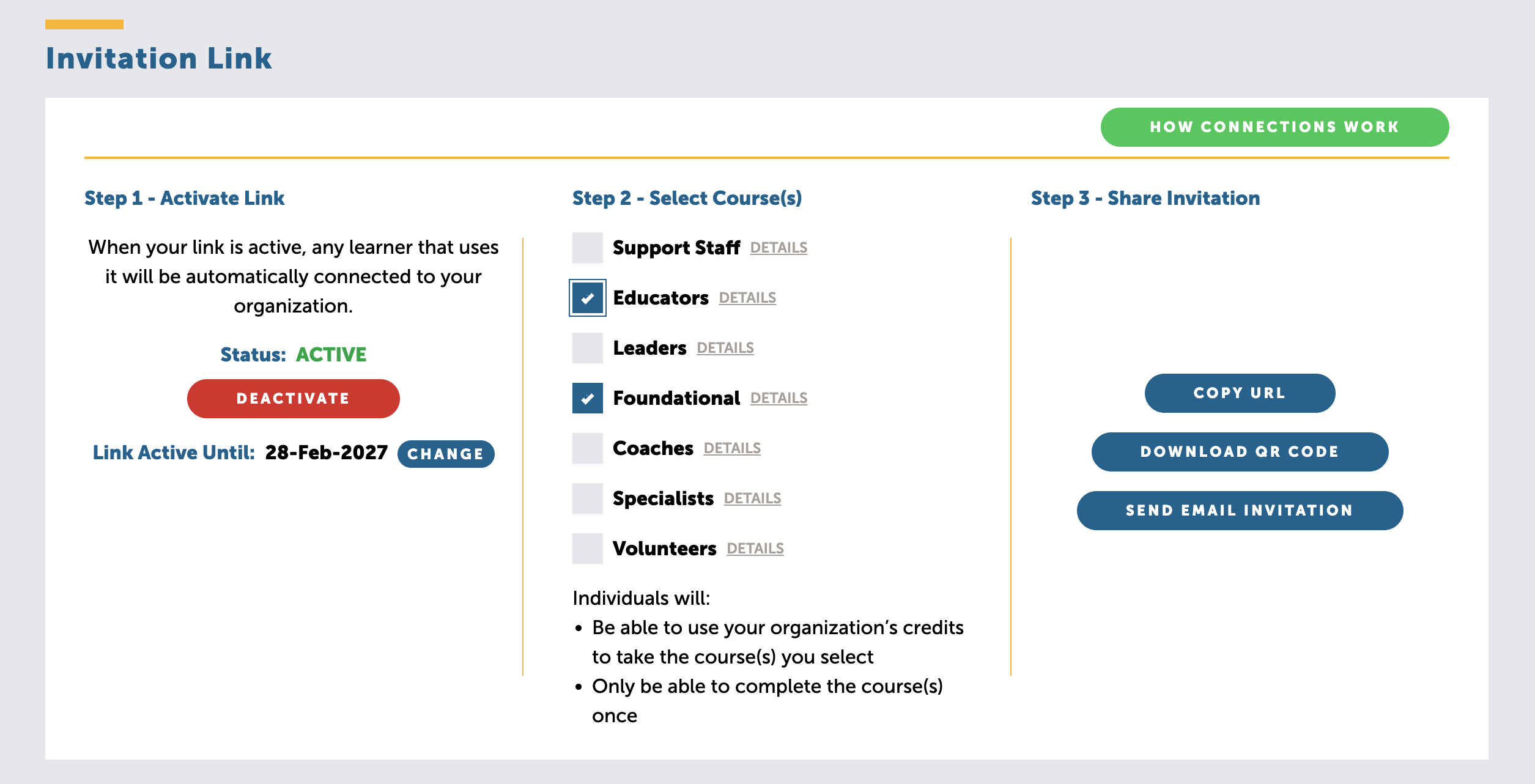
Every learner who takes the course needs to register an account on our platform. This is true for individuals who purchased the course for themselves and those using an organization’s credits to take the course.
Learners using an organization’s credits need to connect their account to the organization.
When a learner is connected to your organization:
- The learner can use credits the organization purchased to take the course.
- The organization can terminate any in-progress session that uses their credits.
- The organization will see all of the learner’s certificate and in-progress session information, including information that does not involve the organization’s credits. This allows the organization to see certificates the learner earned outside the organization.
Either the learner or the organization may disconnect at any time. Once disconnected, the learner will retain their certificate.
Visit the Connections section of the ChildSafeguarding.com dashboard for more information.
Accessing the Course
Our bespoke eLearning platform was developed to provide access to our courses to all learners.
To access the course, learners will need to register for an account. They will then need access to credits. They can buy credits for themselves or use organization credits by connecting to an organization.
The learning interface for the course is designed for universal understanding, including buttons, labels, text, and subtitles that are presented in the language of instruction.
The course is accessible through any internet enabled device, including computers, laptops, tablets, and phones. It is adaptive to mobile devices in both portrait and landscape mode. The course is web-based and accessible on any browser. No software or apps need to be installed.
Our eLearning experience ensures that any learner can access the course successfully, regardless of geography, literacy level, or technical experience.
Expected Outcomes
- Reduced child abuse in your community
- Safer environment for children
- Upskilled staff
- Trained employees that understand their Duty of Care
- Improved reputation for your organization
- Alignment to legal requirements
- Stay up-to-date with Child Protection knowledge
BUY A PACKAGE OR A COURSE
What Customers Say About ChildSafeguarding.com
Director of Education Quality Assurance & Accreditation,Vinschool Education System
At Vinschools we have a strong commitment to child protection and we understand that every adult in the Vinschool community has an integral role to play in ensuring we provide a safe and secure environment for our students. Our investment in the easily accessible and user-friendly training provided by ChildSafeguarding.com is not only helping to protect our students in this context, but has also supported a clear message to all our stakeholders about what is important to us.